
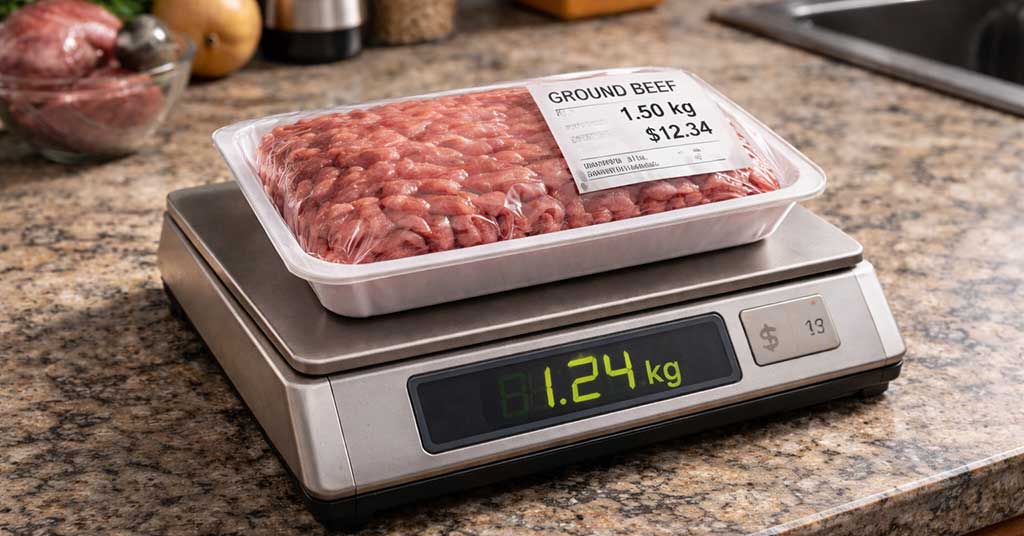
Food fraud isn’t just about high-profile heists; it’s happening at your local meat counter

Once again, it took the media to remind us that food fraud is not a relic of the past.
After the 2011–2012 Great Canadian Maple Syrup Heist, which saw millions of dollars’ worth of syrup stolen from a Quebec strategic reserve stockpile, CBC News has uncovered another troubling issue: inaccurate scales at the meat counter.
This is not a one-off mistake. It points to a problem in how the system operates.
When consumers pay for more than they actually receive, the consequence is not just irritation. It is a silent erosion of trust in one of the most expensive categories in the grocery store.
The implications are far from trivial. Canada counts roughly 16 million households, each spending over $16,000 annually on food. If about 20 per cent of that goes to meat, we are looking at a $50-billion market.
The discrepancies identified suggest overcharges ranging between four per cent and 11 per cent on affected packages. If this were systemic, which it likely is not, the exposure would be staggering. But even under conservative assumptions, where only 10 to 25 per cent of transactions are impacted, the national cost still ranges from roughly $200 million to $1.4 billion annually.
That is a hidden cost on consumers, one that never shows up in inflation data yet directly affects household budgets at a time when affordability is already stretched thin.
But this raises a far more uncomfortable question: where are the inspectors? Canada does not lack oversight bodies. Measurement Canada, the federal agency responsible for inspecting and certifying commercial measuring devices such as grocery scales, is mandated to ensure accuracy in trade measurement while the Canadian Food Inspection Agency (CFIA), which focuses primarily on food safety and labelling compliance, plays a broader role in food integrity.
Yet, when it takes investigative journalism to uncover issues of this magnitude, we have to question whether the system is adequately resourced or sufficiently proactive.
This concern is amplified by recent signals that the federal government is cutting inspector positions within the CFIA. At a time when scrutiny should be intensifying, capacity may in fact be shrinking. Reports and union statements have raised concerns about potential reductions, though the full scope and impact have not been publicly detailed. Fewer inspectors could mean fewer audits, slower response times and ultimately weaker surveillance across the food system.
In other words, the very moment Canadians are demanding more oversight may coincide with a diminished ability to deliver it.
What is perhaps of more concern is how common these discrepancies appear to be. Social media is now filled with consumer testimonies showing mismatches between labelled and actual weights. In an era of record inflation, this lack of rigour is an expensive oversight that comes straight out of the consumer’s pocket. Whether these inaccuracies stem from malfunctioning equipment, inadequate calibration or poor staff training is almost secondary. The outcome is the same: consumers are paying more than they should.
Some grocers have issued apologies, but apologies alone are not enough. When the integrity of measurement is compromised, so too is the integrity of pricing. And in a country where food affordability is already under intense pressure, even small discrepancies compound into meaningful financial burdens for households.
Consumers, for their part, are not powerless. A simple kitchen scale, costing less than $20, can act as a first line of verification. Document any discrepancies and bring them to the attention of store management. Under the Scanner Price Accuracy Code, consumers may be entitled to compensation. The code is voluntary and applies primarily to major retailers, not all stores. Issues should also be reported to regulators, particularly Measurement Canada, even if enforcement can be slow.
Ultimately, grocers must recognize that having a “thumb on the scale,” whether intentional or not, is indefensible. But regulators must also accept their share of responsibility. Oversight cannot rely on whistleblowers and journalists to function effectively. Precision in measurement is not optional in food retail. It is foundational.
Dr. Sylvain Charlebois is senior director of the Agri-Food Analytics Lab at Dalhousie University and co-host of The Food Professor Podcast.
Explore more on Food prices, Cost of Living, Food industry
The views, opinions, and positions expressed by our columnists and contributors are solely their own and do not necessarily reflect those of our publication.
Troy Media empowers Canadian community news outlets by providing independent, insightful analysis and commentary. Our mission is to support local media in helping Canadians stay informed and engaged by delivering reliable content that strengthens community connections and deepens understanding across the country.

