
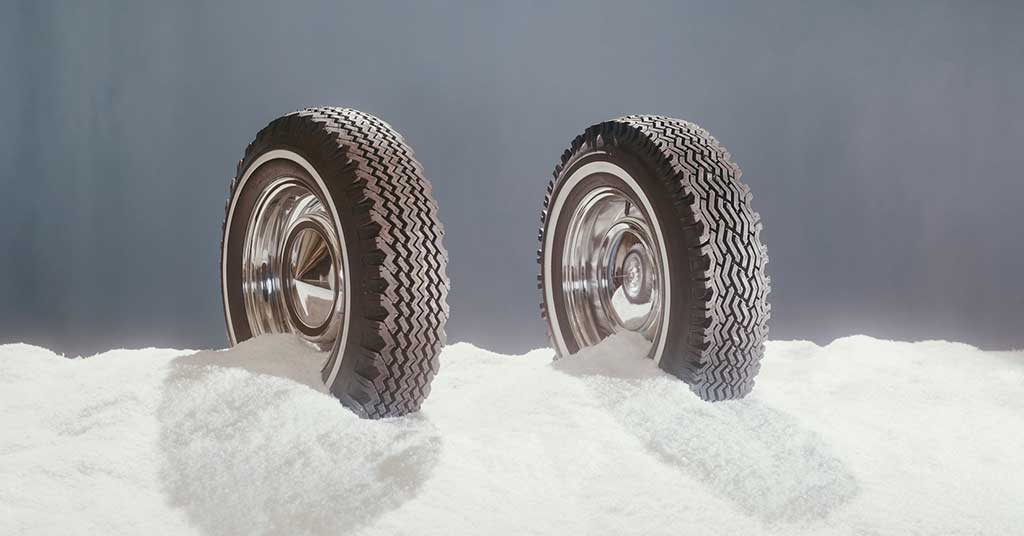
Winter tires give you a fighting chance on ice and slush, cutting those “I couldn’t stop” moments that our winters are famous for

Putting off buying winter tires because they’re too expensive? You’re not alone.
A new study finds that one in three drivers says they are now less likely to buy winter tires because of increased financial pressures. Yet that same survey, conducted by Probe Research for the Tire and Rubber Association of Canada, also found that most Canadians believe winter tires are more important than ever. Three-quarters of those surveyed say extreme winter weather events make snow tires necessary, and more than four in five say driving on winter tires has saved them from an accident or loss of control.
So what makes a winter tire different from a summer tire?
In Canada, a true winter tire is identified by the three-peak mountain and snowflake symbol on the sidewall, showing it meets industry standards for severe snow conditions.
“The (rubber) compound (in a winter tire) is designed to be flexible, allowing grip in cold temperatures—below +7C,” says Jennifer Taylor, senior technical product specialist at Continental Tire Canada. “A summer tire compound in winter temperatures gets very hard and doesn’t have the flexibility—and therefore less grip,” she explains.
On top of the softer rubber compound, the tread pattern on winter tires is designed to clear water, slush and snow so the rubber can stay in contact with the road surface. “One of the key objections to winter tire use is the feeling that all-season tires are good enough. But a summer tire is best for summer conditions, and a winter tire is best for winter conditions,” Taylor says.
All-season tires, on the other hand, are built to work across a range of temperatures, but they are not engineered for Canada’s colder winter conditions. “If you’re in a place where there’s a lot of ice and it’s always in the minus 20s or 30s, you might need a different tire than someone in Southern Ontario or the Maritimes, where there’s maybe more snow, but the temperatures aren’t as severe,” she says.
And that variation in weather is reflected in how Canadians approach winter tires. Winter tire use is strongest in the regions that see the toughest winter driving. In Atlantic Canada, 95 per cent of drivers use winter tires. In Ontario, 77 per cent use winter tires. That drops to 70 per cent in Manitoba, Saskatchewan and Alberta.
In British Columbia, usage is 64 per cent, partly because of milder winters in some areas. Winter tires are mandatory in B.C. from Oct. 1 to April 30 in certain regions, with some exceptions in the Lower Mainland and southeastern Vancouver Island. On signed mountain and rural routes during that period, drivers must have winter-rated tires or carry chains, and those who do not comply can be turned around or fined at enforcement checkpoints.
In Quebec, winter tires are mandatory from Dec. 1 to March 15 on all passenger vehicles, including taxis and rental cars. Vehicles registered in Quebec that do not meet the requirement during that period can face fines under provincial law. Other provinces set restriction dates for studded tires, which reduce stopping distances on ice. Only the territories, Alberta and Saskatchewan have no restrictions on studded tire use.
Since Quebec brought in legislation in 2008 requiring winter tires, there has been a 40 per cent decrease in winter-related vehicular fatalities, according to the Société de l’assurance automobile du Québec.
While there is an upfront cost to buy a second set of tires and to have them changed over twice a year, that cost is partly offset by the fact that each set will see fewer kilometres than if you ran a single set year-round. The added expense is also outweighed by the reduced chance of an accident that could result in injuries and damage to your vehicle.
Consumer Reports found that winter tires stopped an average of about 1.8 metres (six feet), or 25 per cent, quicker than all-season tires on ice. That improved stopping distance can make the difference between a close call and a collision.
Even with the best winter tires, Taylor said that you still share the road with drivers on all-season rubber. “What about the driver behind you who thinks they’re a good driver and is not using winter tires? If you stop quickly, thanks to your winter tires, but they couldn’t stop, now your vehicle has been damaged.”
For Canadian drivers facing months of snow, ice and freeze-thaw cycles, a proper set of winter tires is one of the most effective safety upgrades you can make to your vehicle. The upfront cost is real, but so are the gains in grip, control and peace of mind every time the temperature drops.
Dale Johnson is an award-winning author, broadcaster and journalist who has worked in TV, radio, print and online.
Explore more on Automotive maintenance, Consumer information
The views, opinions, and positions expressed by our columnists and contributors are solely their own and do not necessarily reflect those of our publication.
Troy Media empowers Canadian community news outlets by providing independent, insightful analysis and commentary. Our mission is to support local media in helping Canadians stay informed and engaged by delivering reliable content that strengthens community connections and deepens understanding across the country.

