
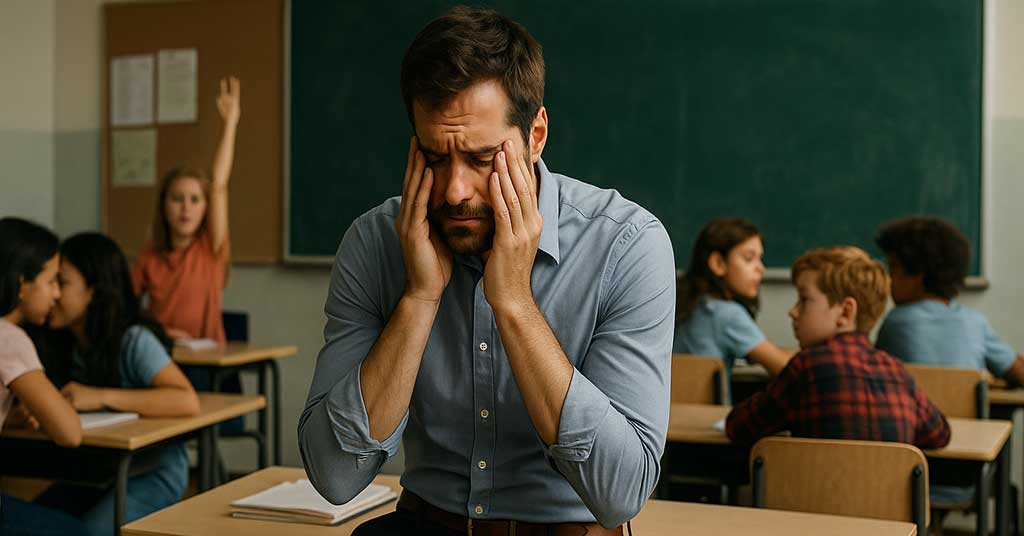
Student violence is rising and classrooms are becoming unsafe, yet officials expect teachers to carry on as if nothing is wrong

At the beginning of August, Manitobans learned that a Brandon police officer, Const. Moshe Linov, was invested in the Order of the Buffalo Hunt. This is an extremely high honour, and Const. Kinov received it because he disarmed a student who had seriously injured another student with a machete in a Brandon public school.
Obviously, when parents send their children to school, they don’t expect them to be confronted by other students who threaten their lives or disrupt their education. Likewise, when teachers and educational assistants (EAs) go to work, they expect to be treated with respect and not to fend off students who want to assault them, physically or verbally.
This expectation was common in the past, but not today.
Physical violence and verbal assaults in public schools are on the rise. A recent report from the Workers Compensation Board published in a Winnipeg Free Press editorial on July 22 shows that, over the last decade, there was more than a 300 per cent increase in requests for compensation from teachers and EAs who say they were injured on the job. These professionals reported being kicked, punched, bitten and spat on by students. There are also untold stories of educational workers being verbally abused, threatened and disrespected.
But behind every statistic is a story—one that brings the data into sharp, uncomfortable focus.
Recently, a male student asked to go to the bathroom in a class taught by a teacher friend of mine in a large Winnipeg high school. Of course, the student was given permission, but he didn’t return. Soon another staff member knocked on my friend’s classroom door asking for the student’s backpack.
My friend assumed the student was ill and was going home. Later, she learned that this student was caught in drug-related activities in the washroom. When administrators searched his backpack, they found knives and a can of mace.
She waited for a staff meeting, some kind of debrief, but nothing happened.
Teachers and EAs are professionals, and they deserve to know what happened and what has been done to ensure that students do not bring weapons to school. My friend thought that this student may have been suspended but within a week he was back in her classroom.
That lack of urgency is not an isolated oversight—it’s baked into the system. And it mirrors the tone of Manitoba Education and Early Childhood Learning’s most recent policy guideline.
The casual response of school administrators to this incident is highlighted in the title of the recent guideline published by Manitoba Education and Early Childhood Learning, Safe and Caring Schools: Provincial Code of Conduct: Behaviour Intervention and Response Using a Student-Centred and Strength-Based Approach.
In commenting on this guideline, the minister, Tracy Schmidt, said that teachers need to act as “social workers,” as if teaching isn’t difficult enough.
As expected, this guideline looks good on paper as a government document, but when teachers tell me the grim reality they experience, it is obvious that they are expected to do things that cannot be done in schools.
That delusion has consequences.
The question that many parents, teachers and EAs want answered is: Why don’t educational officials realize that some children have psychological and physical problems that cannot be corrected by teachers? These children need special treatment in specially designed institutions that can respond to their unique needs.
To common sense observers, it is obvious that not all school-aged children can be accommodated in school classrooms without negatively affecting other students. Some students need separate settings for the safety of other children and for their own safety. Most importantly, teachers need to be able to focus on their primary responsibilities, educating their students, and not acting as social workers or police officers.
If common sense changes are not enacted to stop disrespectful and disorderly behaviour, we will see more police officers coming into schools to quell students’ behaviour that teachers and EAs are forced to endure. We will also see less time and attention being spent on teaching and learning. Hopefully, no educational workers or students will be injured before school administrators crack down on the disorderly and disrespectful behaviour that is undermining the quality of education experienced by Manitoba students.
Rodney A. Clifton is a professor emeritus at the University of Manitoba and a senior fellow at the Frontier Centre for Public Policy. Along with Mark DeWolf, he is the editor of From Truth Comes Reconciliation: An Assessment of the Truth and Reconciliation Commission Report, published in 2024.
Explore more on Conflict management, Bullying
The views, opinions, and positions expressed by our columnists and contributors are solely their own and do not necessarily reflect those of our publication.
Troy Media empowers Canadian community news outlets by providing independent, insightful analysis and commentary. Our mission is to support local media in helping Canadians stay informed and engaged by delivering reliable content that strengthens community connections and deepens understanding across the country.

