
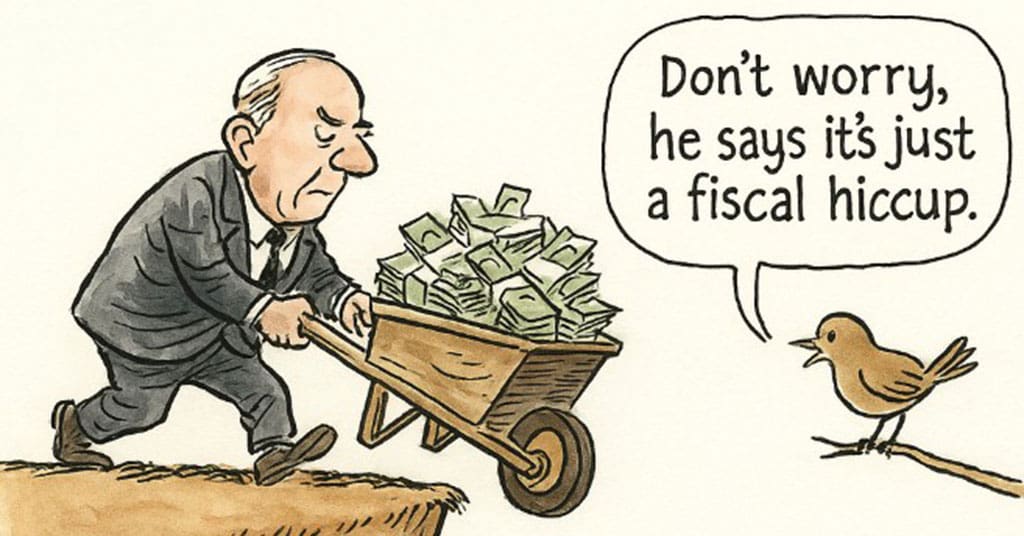
Debt projected to hit $23.5 billion after another year of overspending

The Saskatchewan government has a spending problem, and taxpayers are the ones paying the price. In 2024 alone, the province blew past its own budget by nearly $1 billion, continuing a years-long pattern of fiscal mismanagement.
A budget ensures you only spend within your means, not on fast food or new accessories for your truck. But a budget only works if you follow it. Saskatchewan’s government has been ignoring its own numbers, and residents are bearing the cost.
The government originally projected it would spend $20.1 billion last year. But the newly released public accounts, which mark the end of the 2024 fiscal year, show it spent $21.1 billion.
That’s about $970 million more than what the government said it would spend.
Much of that overspending came from key ministries. Nine of 11 main departments blew past their allocations. That includes $8.5 million in excess spending in a vaguely labelled category called “general government,” a catch-all line item that often includes internal operations, administration and unallocated funds.
Taxpayers should be skeptical of a government that can’t even stay within its own budget in something as broad and undefined as general government. And this isn’t a one-off. Saskatchewan’s government has made a habit of underpromising and overspending.
In 2023, the province ran $2.2 billion over budget. In 2022, it was $1.4 billion. In 2021, $2.5 billion.
Years of overspending have taken a toll. Saskatchewan’s debt has ballooned as a result. Like households, governments that take on too much debt face rising interest costs, leaving less room for essential services like health care, education and infrastructure.
When Saskatchewan Premier Scott Moe took office in 2018, the provincial debt stood at about $11 billion. By the end of this year, it’s projected to reach $23.5 billion. Moe’s government will have more than doubled the debt in seven years.
And the debt could go even higher if the government continues to ignore its own spending projections.
That has real consequences. Debt isn’t free. In 2024, interest payments cost Saskatchewan taxpayers $699 million, about $560 per person. This year, those payments are expected to climb to $878 million, or $702 per person.
To put that in perspective, that’s more than double what a family of four earning $75,000 can expect to pay in fuel taxes this year. Every dollar your family pays at the pumps isn’t going toward roads or highways. It’s being diverted to cover interest on the debt.
That’s a waste of your tax dollars.
And it didn’t have to be this way. Government revenues also increased by about $994 million over what was projected in the 2024 budget. Had the province kept its spending in check, that extra revenue could have been used to start reducing the debt and the interest charges that come with it.
Instead, the government chose to spend nearly all of it.
A budget isn’t supposed to be a suggestion. It’s a commitment taxpayers should be able to trust: a transparent document that outlines how public money will be managed.
Breaking that commitment erodes public trust and raises serious questions about accountability.
Saskatchewan doesn’t have a revenue problem. It has a spending problem. Sticking to the budget is the first step toward restoring fiscal discipline and rebuilding taxpayer confidence.
Gage Haubrich is the Prairie Director of the Canadian Taxpayers Federation.
Explore more on Saskatchewan budget, Saskatchewan debt and deficit, Saskatchewan taxes, Moe government
The views, opinions, and positions expressed by our columnists and contributors are solely their own and do not necessarily reflect those of our publication.
Troy Media empowers Canadian community news outlets by providing independent, insightful analysis and commentary. Our mission is to support local media in helping Canadians stay informed and engaged by delivering reliable content that strengthens community connections and deepens understanding across the country.

