
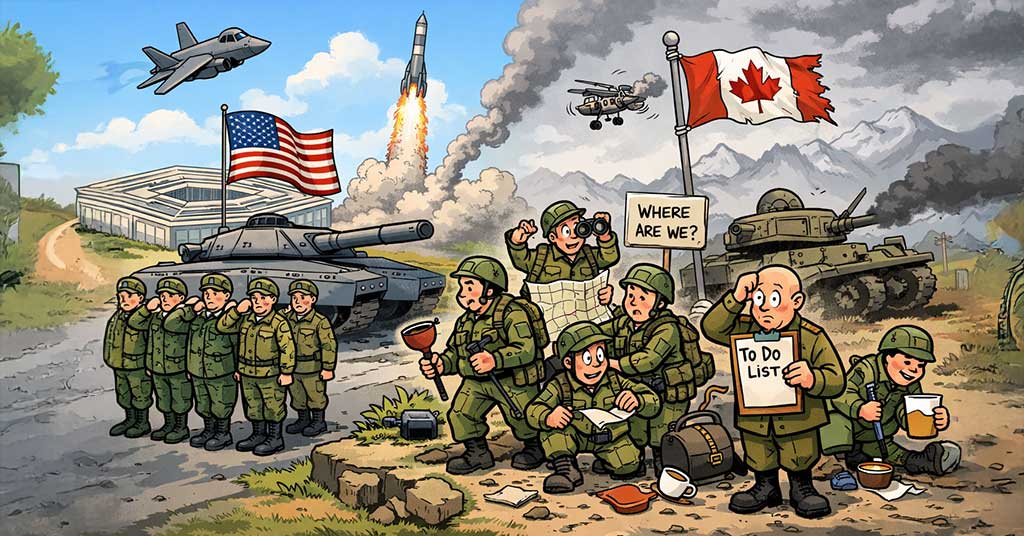
Lacks the military strength and security systems needed to defend itself without relying on the United States
WINNIPEG — Canada cannot remain a sovereign nation simply by declaring itself one. It must have the political will, institutions and capabilities to defend that sovereignty, according to a new report from the Frontier Centre for Public Policy.
Without the ability to protect its borders, defend its territory, safeguard essential infrastructure and respond to national emergencies, Canada risks becoming increasingly dependent on other countries to protect its interests. That dependence, the report warns, could ultimately limit Ottawa’s freedom to make decisions in Canadians’ best interests.
The report, Canada’s Dilemma: Sovereignty and National Security, argues that successive Canadian governments have neglected fundamental security responsibilities while continuing to assure Canadians that their country’s sovereignty is secure.
 David Redman
Written by David Redman, a retired Canadian Army lieutenant-colonel and former head of the Alberta Emergency Management Agency, the report examines 10 interconnected areas of national security, including intelligence, border protection, policing, critical infrastructure, emergency management and the Canadian Armed Forces.
“Canadians hear a great deal about defending our sovereignty, but we rarely hear a serious discussion about what that actually requires,” Redman said. “Sovereignty means having the ability to defend our country and make our own decisions. Without the institutions and capabilities to do that, the word becomes little more than political rhetoric.”
Redman identifies several areas of concern, including intelligence warnings he argues governments have failed to act on, limited physical inspection of shipping containers, inadequate protection of critical infrastructure and weaknesses in military readiness.
These shortcomings have consequences beyond national defence. An attack on electricity or communications systems could disrupt entire communities. Weak border security could allow dangerous goods or other threats to enter the country. Inadequate emergency preparedness could leave municipalities struggling to respond to floods, wildfires or other disasters.
Redman also warns that Canada’s dependence on the United States for continental defence and intelligence carries risks. He argues that Washington’s concerns about Canada’s security commitments could weaken Ottawa’s influence over decisions affecting its own territory.
“Canada cannot expect its allies to protect our sovereignty if we are unwilling to take responsibility for protecting it ourselves,” Redman said. “The stronger our national security capabilities, the stronger our position becomes when dealing with other countries, including the United States.”
The report argues that national security also depends on effective government, protected rights and freedoms, a strong economy and communities capable of responding to emergencies. Redman questions whether increasing centralization of government authority has weakened the ability of municipalities and provinces to act when crises occur.
“National security is not simply a military issue or something governments can address when a crisis occurs,” Redman said. “It also means making sure communities can protect essential services, respond to emergencies and keep people safe when something goes wrong.”
Redman calls for a long-term national strategy that defines Canada’s interests, identifies the threats facing the country and establishes clear responsibilities for protecting Canadians. He argues that governments must move beyond announcements and commitments to ensure the institutions responsible for national security have the resources, authority and capabilities to do their jobs.
Key takeaways
- Canada’s sovereignty depends on its ability to defend itself: Redman warns that political declarations mean little without the institutions and capabilities needed to protect the country and its independence.
- Security weaknesses could affect Canadians directly: Threats to critical infrastructure, border security and emergency preparedness could disrupt essential services and put communities at risk.
- Dependence on the United States carries consequences: Redman argues that Canada’s defence shortcomings could weaken its influence over decisions affecting continental security.
- National security is more than military defence: The report examines 10 interconnected areas, including intelligence, policing, border protection, infrastructure and emergency management.
- Canada needs a long-term national security strategy: Redman calls for clear priorities, defined responsibilities and the resources needed to turn security commitments into operational capabilities.
About David Redman
David Redman served 27 years as an officer in the Canadian Army, retiring as a lieutenant-colonel. His military career included operations in Germany, Egypt, the former Yugoslavia, the United States and across Canada.
In 2004, he became head of the Alberta Emergency Management Agency, where he led the provincial response to the June 2005 floods and the development of Alberta’s 2005 Provincial Pandemic Influenza Plan. He retired in 2013.
He is also the author of the Frontier Centre studies Canada’s Deadly Response to COVID-19 (2021) and Canada 2024: A Confident Resilient Nation or a Fearful Fractured Country? (2024).
About the Frontier Centre for Public Policy
The Frontier Centre for Public Policy is an independent, non-profit research and education organization focused on public policy issues affecting Canadians.
Media contact:
David Leis
President and CEO
Frontier Centre for Public Policy
[email protected]
📢 For press release submissions and distributions, click here.
Explore more on National security, Canada-US relations
The views, opinions, and positions expressed by our columnists and contributors are solely their own and do not necessarily reflect those of our publication.
Troy Media empowers Canadian community news outlets by providing independent, insightful analysis and commentary. Our mission is to support local media in helping Canadians stay informed and engaged by delivering reliable content that strengthens community connections and deepens understanding across the country.

