
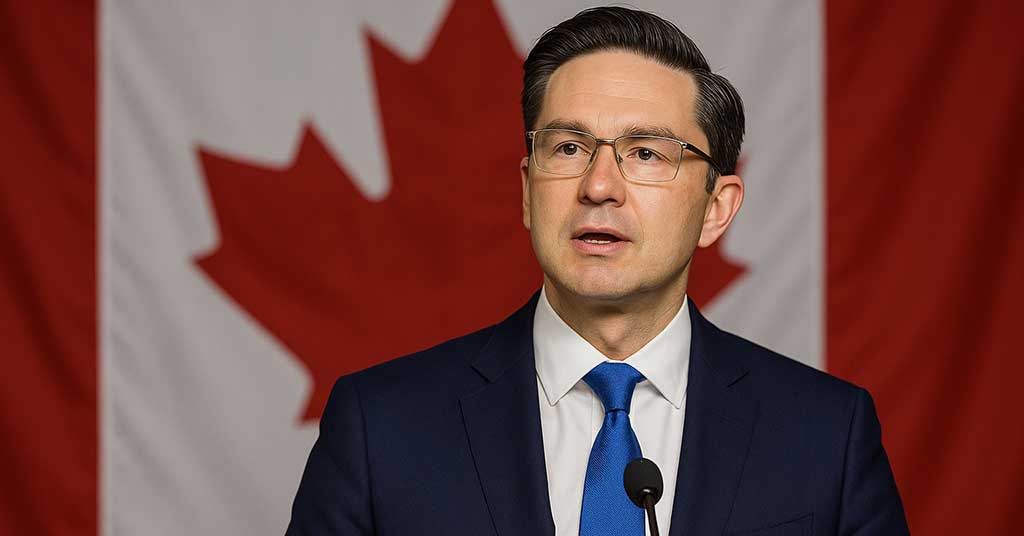
He squandered a commanding lead, lost to Carney and still clings to the style of politics that turned off voters
As unpopular as he was, Justin Trudeau did Canada a tremendous service in early 2025 when he announced that he would step down as prime minister and Liberal Party leader. Looking back a year and a half later, one can only imagine the state that our country would be in today had he not done so.
At the time, Trudeau’s party was polling in the low 20s, and nearly half of Canadians supported the Conservative Party of Canada under Pierre Poilievre. People clearly wanted change.
This is not surprising. Typically, a political party stays in power for about 10 years in Canada before its leadership becomes stale or some sort of scandal leads voters to replace it. We tend to go back and forth between the Liberal Party and some iteration of the Conservatives, with smaller parties also exerting significant influence in our Parliament.
Trudeau had been in office since 2015, and the optimism he had originally brought to Canadians was replaced by disillusionment and frustration.
Pierre Poilievre has led the Conservative Party since September 2022. In the Westminster parliamentary system, a principal function of the loyal opposition is to challenge the government and offer alternative policies consistent with its own platform. Often, debates in our House of Commons become heated, but they generally remain civil. Behind the scenes, parliamentarians are expected to work together to improve the lives of ordinary Canadians.
Poilievre brought a very different style to the role. It seemed that everything became a personal attack against Justin Trudeau. Poilievre was often confrontational with members of the media, and with rare exceptions, the Conservative Party platform became a series of catchphrases repeated ad nauseam in the House of Commons and online.
Canadians clearly wanted change, but was Poilievre their only option?
The Liberal Party of Canada chose Mark Carney, whose economic policies are more business-oriented than Trudeau’s, as its new leader. In the 2025 federal election, Canadians essentially had a choice between Carney’s more business-oriented Liberal Party and the right-wing populist Poilievre. They chose Carney.
Donald Trump’s return to the White House created a new problem for Poilievre. Trump had campaigned for re-election under his Make America Great Again (MAGA) slogan. Poilievre was dubbed “Maple MAGA” for using similar populist tactics. Trump also antagonizes the media and attacks opponents on a personal level.
Trump’s attacks changed the political landscape, while Carney gave voters who wanted change from Trudeau a new Liberal leader to consider. Poilievre’s once-commanding lead disappeared, and his Trump-like political style likely did him no favours.
Yet Poilievre and his party have failed to change course. On Gaza, Poilievre has rejected the claim that Israel is committing genocide, putting him at odds with many Canadians. An Angus Reid Institute poll found that while 74 per cent also believe Israel has a right to exist and defend itself, 52 per cent of Canadians believe Israel is committing genocide in Gaza.
The final nail in the Poilievre leadership coffin could come with the results of three federal byelections on Aug. 31, which will provide another test of Conservative support under his leadership.
If the byelections bring his leadership to an end, good riddance.
Gerry Chidiac specializes in languages and genocide studies and works with at-risk students. He received an award from the Vancouver Holocaust Education Centre for excellence in teaching about the Holocaust.
Explore more on Federal politics, Conservative Party, Populism
The views, opinions, and positions expressed by our columnists and contributors are solely their own and do not necessarily reflect those of our publication.
Troy Media empowers Canadian community news outlets by providing independent, insightful analysis and commentary. Our mission is to support local media in helping Canadians stay informed and engaged by delivering reliable content that strengthens community connections and deepens understanding across the country.

