
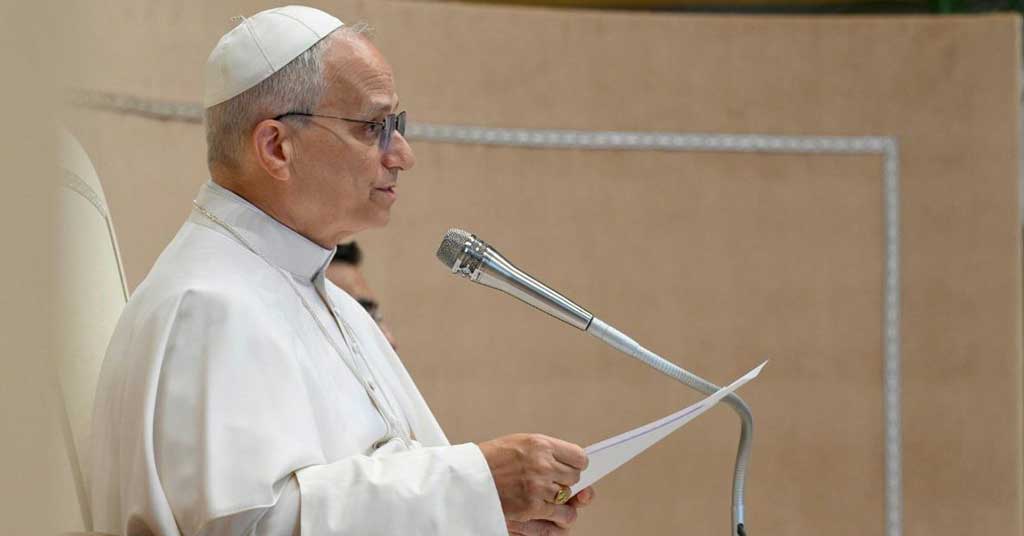
Pope Leo XIV is refusing to give moral cover to politicians who use scripture to justify war
The Roman Catholic Church is pushing back against the Trump administration’s efforts to portray military force as morally justified and, for the first time in decades, is acting as a clear moral check on political power.
As a Catholic who believes that every person is a sacred child of God, I have long been disillusioned by the failures of Church officials to confront political power when it justifies violence.
One defining moment of Pope John Paul II’s papacy was when he took a stand against the Soviet Empire in the 1980s. His message—“Be not afraid”—resonated first with people in his native Poland and became a significant factor contributing to the eventual demise of the Soviet Union.
However, that legacy of moral pushback has often been replaced by a quiet compliance, allowing modern political leaders to co-opt religious imagery for their own ends. For example, American Secretary of Defense Pete Hegseth has used language invoking divine justification to frame military action, citing scripture about God who “trains my hands for war,” while also using the military doctrine term “overwhelming violence of action” to describe how that force should be applied.
What has been missing is a Church willing to confront that justification directly and publicly.
That is now changing.
Like John Paul before him, Pope Leo XIV understands how political messaging works. As an American, he understands the culture he is challenging. In his Palm Sunday sermon, he rejected the idea that violence can be justified through religious language.
Timothy Broglio, who oversees Catholic ministry to U.S. armed forces, has also raised concerns about whether the conflict in Iran meets just war criteria. He advised Catholics involved in the fighting to minimize harm and preserve innocent lives.
And the United States Conference of Catholic Bishops has reiterated that Catholic teaching allows war only in self-defence and as a last resort.
U.S. Vice President J. D. Vance personally delivered an invitation from Donald Trump to Pope Leo for the 250th anniversary of the founding of their country this year. The Pope rejected the offer, choosing instead to spend July 4 with people on the Italian island of Lampedusa, a key transit point for migrants crossing the Mediterranean.
That clarity has not been universal. Pope Leo, like his predecessor Pope Francis, has been outspoken in support of the rights of Palestinians. The current war in Gaza followed the October 2023 attack by Hamas on Israel, in which civilians were killed and hostages taken, triggering a large-scale Israeli military response that has included sustained military operations in Gaza. Nearly two years later, the scale of human suffering in Gaza is undeniable. The Catholic Church in Canada took far too long to speak with the same clarity.
The Church will no longer lend moral cover to political power when it believes that power is being misused. When political leaders frame violence as righteous and necessary, and no major institution challenges that framing, it becomes easier to expand, justify, and normalize. That is how limits disappear. That is how civilians become collateral.
Now the Catholic Church is doing so, clearly, publicly and without apology.
Gerry Chidiac specializes in languages and genocide studies and works with at-risk students. He received an award from the Vancouver Holocaust Education Centre for excellence in teaching about the Holocaust.
Explore more on Catholicism, Religion, War/Conflict, Trump administration
The views, opinions, and positions expressed by our columnists and contributors are solely their own and do not necessarily reflect those of our publication.
Troy Media empowers Canadian community news outlets by providing independent, insightful analysis and commentary. Our mission is to support local media in helping Canadians stay informed and engaged by delivering reliable content that strengthens community connections and deepens understanding across the country.

